
Your book is full on Tuesday. By Thursday you have a gap at 2 p.m. and another Saturday morning. You meant to post on Google, answer that review from last month, and update the prices page on your site. Instead you treated six clients, did laundry, and answered texts.
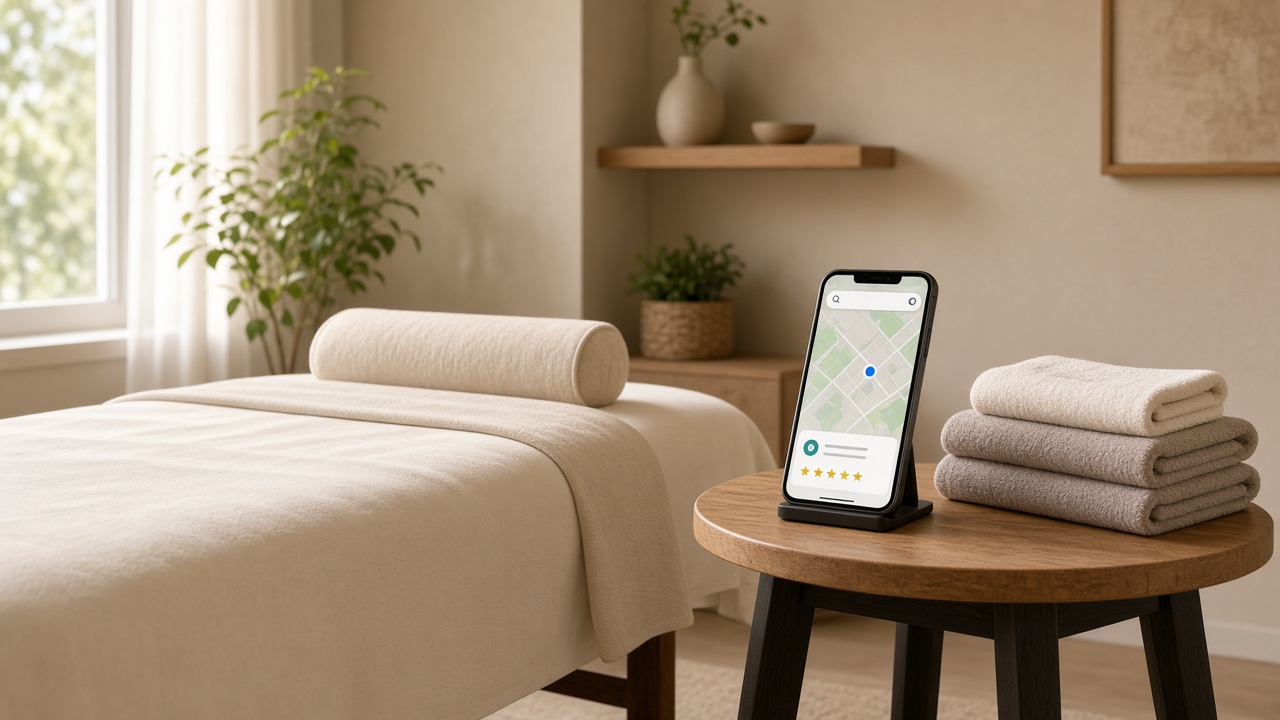
Meanwhile, someone two miles away searches "massage near me" and books with the practice that shows up first on the map. That practice may not be better than you. It is just more visible, more recently active, and easier to trust at a glance.
This guide is the foundation for everything else we publish on local marketing for bodywork. It covers what local marketing actually means for a massage, chiropractic, PT, or skincare practice, how people really choose a provider, the four parts of a workable system, and a routine you can keep when marketing only gets the leftovers of your week.
No ranking promises. Google decides rankings, and anyone who guarantees you the top spot is guessing or selling. What you can control is whether you give Google and prospective clients clear, current, trustworthy reasons to pick you.
What "local marketing" actually means for a bodywork practice
For most bodywork practices, local marketing is not ads, a viral Instagram, or a monthly newsletter. Those can help, but they are not the core.
The core is four things working together:
- Your Google Business Profile — the listing that appears in Google Maps and the "map pack" of three results on a local search.
- Your reviews — how many, how recent, what they say, and how you respond.
- Your website — whether it clearly explains your services, where you are, and why someone should book you.
- Consistency — small, regular updates that keep all of the above current.
Think of it as a system, not a campaign. A campaign has a start and end. A local system is closer to keeping your treatment room clean: a bit every week, and it quietly shows when you skip it.
The reason this matters more for bodywork than for many businesses: your clients are local by definition. Nobody drives 90 minutes for a 60-minute massage they could get nearby. You are competing within a few miles, against a handful of practices, for people who are ready to book soon.
How clients actually find and choose you
It helps to walk through the path a typical new client takes. It is usually short.
Step 1: The search
Most start on a phone with something like "deep tissue massage near me," "chiropractor open Saturday," "sports massage [town]," or "facial near me." Many of these searches include no city name. Google uses the person's location to decide what is "near."
That is why your homepage is often not where the first impression happens. For local searches, the map results usually appear above or alongside the regular website results. (We go deeper on this in why near-me searches matter more than your homepage.)
Step 2: The map pack scan
The searcher sees three or so listings with star ratings, review counts, hours, and a photo. In a few seconds they rule out anyone who looks closed, has few or old reviews, or seems to offer the wrong thing.
A common real-world example: a skilled therapist with 14 reviews, the newest from two years ago, sits next to a chain location with 300 reviews and photos from last week. Quality aside, the chain looks more alive.
Step 3: The profile or review deep-dive
Interested people tap into a listing. They read the most recent reviews, look at photos of the space, check whether you offer the specific service (prenatal, cupping, dry needling, lymphatic drainage, acne facials), and look at how you replied to reviews — especially critical ones.
Step 4: The website check
Not everyone visits your site, but the careful ones do, particularly for higher-priced services, injuries, or first visits to a chiropractor or PT. They want proof: who you are, credentials, what a first session involves, prices or at least price ranges, insurance or cash-pay info, parking, and an easy booking button.
Step 5: Booking (or bouncing)
If online booking is one tap away, many book immediately. If they must call during business hours while you are with a client, some will try the next listing instead.
Takeaway: Every step is a place to lose someone. Local marketing is mostly about removing reasons to leave at each step.
The four pillars of a workable local system
Each of these has its own in-depth guide. Here is the overview and how they connect.
1. Google Business Profile: your real front door
For many practices, the profile gets more views than the website. Yet it is often set up once and forgotten.
What matters most:
- Primary category. "Massage therapist" vs. "Massage spa" vs. "Day spa" vs. "Physical therapist" vs. "Chiropractor" vs. "Skin care clinic." The primary category has a strong influence on which searches you appear for. Pick the one that matches what you mostly do, not what sounds fanciest.
- Services list. Add the specific services people search for, in plain language.
- Accurate hours, including holiday hours. Showing open when you are closed is a fast way to earn an annoyed review.
- Real photos of your space, entrance, and (with consent) you at work. Stock photos do little for trust.
- Posts and updates about availability, new services, or seasonal offers.
A Google quirk worth knowing: owners do not fully control what appears. Google can accept "suggested edits" from the public or change details based on other sources. Check your profile regularly rather than assuming it still says what you entered.
Also: if you work from a home studio or rent a room inside another business, how you list your address matters and Google's guidelines are specific. Getting it wrong can lead to suspension.
Full detail: Google Business Profile optimization for bodywork practices.
2. Reviews and reputation: social proof with a privacy catch
Reviews influence both visibility and decisions. Recency matters to people as much as volume — a steady trickle beats a burst two years ago.
The practical problem for most therapists is not getting reviews from unhappy clients. It is that happy clients forget. A simple, consistent ask (a short text or email after the session with a direct review link) usually does more than any clever tactic.
Responding is where bodywork differs from a restaurant. Your replies must never confirm that a reviewer is or was a client. That means no "Thanks for coming in for your sciatica treatment, Sarah!" and no details about their session, condition, or history — even in a positive reply. For PTs and chiropractors, health privacy rules may apply directly; for massage and skincare, it is still the professional standard and what clients expect.
Safe pattern for a positive review:
"Thank you for the kind words. We appreciate you taking the time to share this."
Safe pattern for a negative review:
"We take feedback seriously and would like to understand more. Please contact our office directly at [phone] so we can talk privately."
Neither confirms a relationship or reveals anything. Neither argues in public.
Never offer discounts or gifts in exchange for reviews, and do not filter who you ask based on whether you expect a good review. Both conflict with Google's policies and can get reviews removed.
Full detail: review management and reputation for therapists (coming soon).
3. Your website: the proof layer
Many bodywork sites are five pages built years ago: Home, About, Services, Contact, Book. The services page lists "Swedish, Deep Tissue, Hot Stone" with one sentence each. Prices are out of date. The bio mentions a certification but not who the therapist helps.
That site is not useless, but it gives Google and people very little to work with.
A stronger local site:
- Has one clear page per main service, explaining who it is for, what a session is like, length and price, and common questions.
- States where you are in plain text: neighborhood, landmarks, parking, accessibility.
- Shows credentials and experience in human terms ("I've worked with runners training for their first marathon for eight years") along with license numbers where relevant.
- Makes booking obvious on every page, especially on mobile.
- Stays consistent with your Google profile: same name, address, phone, hours.
You do not need a 200-page site. You need the pages that answer the questions clients ask you on the phone.
Full detail: website content and local SEO for practice owners (coming soon).
4. Consistency: the part everyone skips
The first three pillars are mostly about setup. This one is about upkeep, and it is where most practices fall down.
Signs of a stale presence:
- The last Google post was in spring.
- Three reviews are sitting unanswered.
- The website still lists last year's prices or a therapist who left.
- Nobody has opened Google Analytics or Search Console since the site launched.
None of this is a disaster alone. Together, they tell clients (and probably Google) that nobody is minding the store.
A realistic weekly and monthly cadence
Here is a routine built for a solo practitioner or small team. It assumes marketing gets small, scheduled slots — not a free afternoon you will never have.
Weekly (about 30 minutes total)
- Reviews (10 min): Respond to any new reviews using privacy-safe language. Send review requests to the week's clients who agreed to receive follow-ups.
- Google profile (10 min): Publish one short update (open slots, a seasonal service, a helpful tip). Add a photo if you have a new one. Glance at the profile for unexpected changes.
- Quick numbers check (5–10 min): How many calls, direction requests, website clicks, and bookings came in? Is anything noticeably up or down?
(Step-by-step version: a realistic weekly marketing checklist for solo therapists.)
Monthly (about 1–2 hours)
- Update one website page: refresh a service description, add FAQs you heard this month, fix prices.
- Check hours and holiday closures for the coming month on both Google and your site.
- Look at which searches brought people to your site in Search Console, if it is set up. Do they match the services you want more of?
- Add a handful of new photos to your profile.
Quarterly
- Review your Google categories and services list against what you actually offer now.
- Read your last three months of reviews for patterns: what do people mention? Use that language on your site.
- Decide on one bigger improvement for the next quarter (a new service page, better photos, a booking fix).
Takeaway: Small and regular beats big and occasional. A 30-minute weekly habit kept for six months will usually do more than a weekend overhaul that is never repeated.
Common mistakes that waste hours
These come up again and again with practice owners.
Chasing social media before the basics. Instagram can build loyalty with existing clients, but for most practices it is not where new local clients search. If your Google profile and reviews are neglected, start there.
Keyword-stuffing the business name. Changing your listing name to "Serenity Massage Best Deep Tissue Massage Downtown" violates Google's guidelines and risks suspension. Use your real business name.
Buying a "local SEO package" without knowing what is done. If a provider cannot tell you plainly what they change each month, you cannot judge whether it is worth it.
Writing generic blog posts. "5 Benefits of Massage" is published on thousands of sites. A page explaining what your prenatal massage session looks like, which trimesters you work with, and how you position clients is more useful and more likely to be found for the right searches.
Ignoring negative reviews or replying angrily. Silence looks like indifference. Defensive replies look worse — and often reveal private details. Use a calm, private-channel reply.
Collecting data you never look at. Having Analytics installed does nothing if nobody opens it. A short weekly snapshot you actually read beats a dashboard you avoid. (More: tracking what works without living in Analytics (coming soon).)
Inconsistent details across the web. An old address on a directory, a different phone number on Facebook, old hours on Yelp. Clean up the main ones once and keep them aligned.
How to prioritize if you only have 15–30 minutes a week
If the routine above still feels like too much, here is the order we would protect:
- Answer reviews (privacy-safe). This is visible to every prospective client who looks at your listing.
- Ask for reviews consistently. One simple ask, made the same way to every client who has agreed to follow-up (not just the ones you expect to be happy). See how to ask for reviews without sounding awkward.
- Keep Google profile hours and services accurate. Wrong info costs bookings directly.
- Post one Google update when you have availability to fill.
- Improve one website page per month, starting with your most-booked or most-profitable service.
If you can only do one thing this week: open your Google profile, read your latest reviews, and reply to any you have not answered.
Getting help without losing control
Practice owners usually choose between three paths: do it yourself, hire an agency or freelancer, or use tools that handle the drafting. Each has trade-offs in cost, control, and time. (We compare them honestly in agency vs DIY vs bots: choosing how to run your marketing (coming soon).)
Whatever you pick, two principles hold:
- You should approve what goes out under your name. Especially review replies, where a careless sentence can create a privacy problem.
- You should never need to hand over client records for marketing. Review replies and service pages do not require them.
This is the gap we built the MBodyBot Bodywork Marketing Toolkit for. It is three bots for $97/month: one drafts Google Business Profile posts and review replies, one drafts website pages and content, and one sends a weekly summary of your numbers from Google Analytics and Search Console. They draft while you treat; you approve before anything goes live. They do not need client records, and they do not promise rankings — nothing honest can. If you would rather do it all yourself, the cadence above works just as well; it simply takes your time instead.
Next steps
Local marketing for a bodywork practice is not complicated. It is just easy to put off when your schedule is full.
Start here:
- This week: Reply to any unanswered reviews using privacy-safe wording, and confirm your Google hours are correct.
- This month: Pick your top service and give it a proper website page.
- Ongoing: Protect a 30-minute weekly marketing slot like you would a client appointment.
Then go deeper on each part of the system:
- Google Business Profile optimization for bodywork practices
- Review management and reputation for therapists (coming soon)
- Website content and local SEO for practice owners (coming soon)
- Why near-me searches matter more than your homepage
The practices that win locally are rarely the ones with the biggest budgets. They are the ones that stay visible, current, and trustworthy, week after week.
